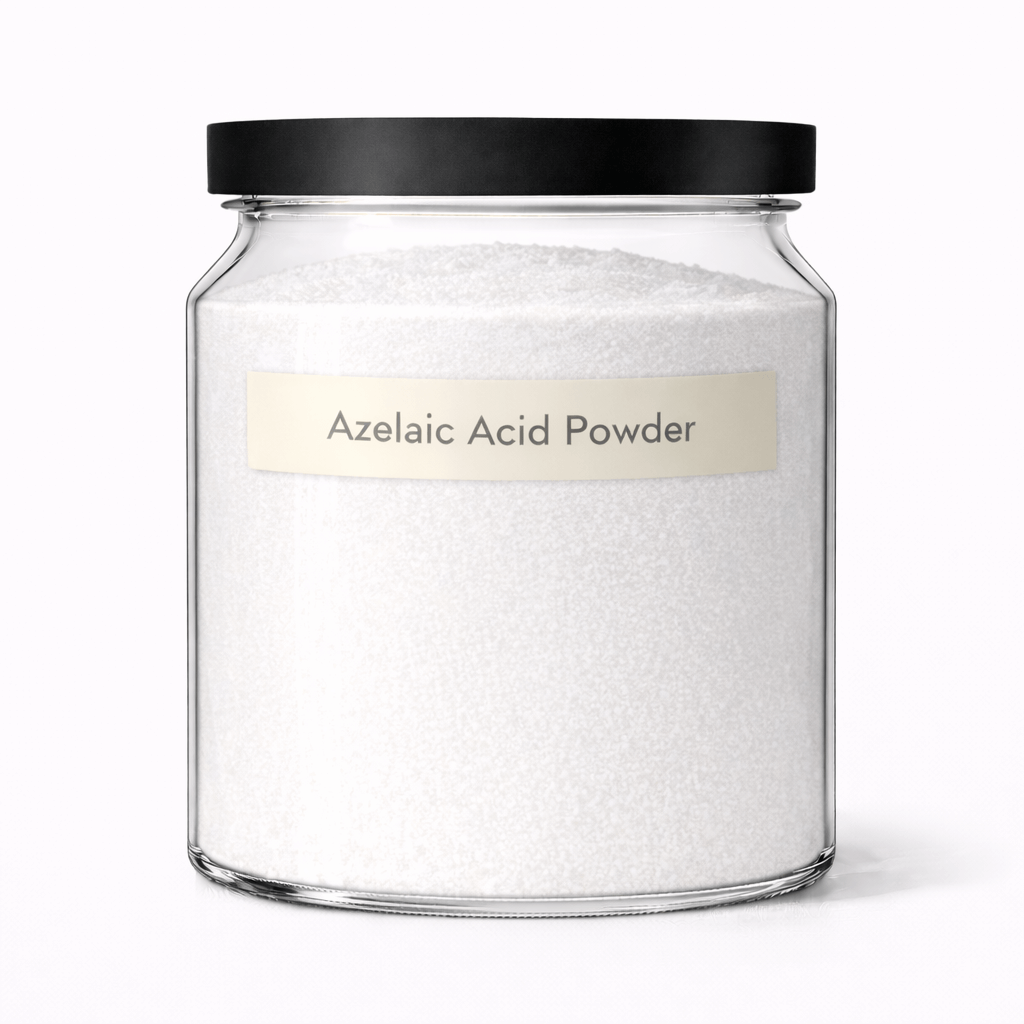
Azelaic Acid Powder
Price range: ₦6,400.00 through ₦29,200.00
Azelaic Acid Powder (Azelaic Acid) is a clinically proven, naturally derived active that simultaneously tackles acne, rosacea, hyperpigmentation, and uneven skin tone. It inhibits melanin production, kills acne-causing bacteria, reduces inflammatory redness, and gently exfoliates — all in one ingredient. Suitable for all skin types including sensitive, rosacea-prone, and melanin-rich skin tones. Pairs powerfully with Niacinamide and Tranexamic Acid. Recommended usage rate: 5% – 10%. Optimal pH: 4.0 – 5.5. Pre-disperse in glycerin before adding to water phase.
If you have rosacea, post-acne marks, melasma, or persistent redness that just will not go away, chances are a dermatologist has already mentioned Azelaic Acid to you. And for good reason. This is not a trendy ingredient that appeared on social media last year. Azelaic Acid is a prescription-strength skincare active that has been clinically studied and dermatologist-prescribed for decades. At Organicsbyjumira, we supply cosmetic-grade Azelaic Acid Powder so that professional formulators and advanced DIY skincare creators can harness its remarkable skin-clearing and redness-reducing power. As a result, you can create genuinely effective products for some of the most persistent and frustrating skin concerns your customers face.
What Is Azelaic Acid and Where Does It Come From?
Azelaic Acid is a naturally occurring dicarboxylic acid. It is found in grains such as wheat, barley, and rye. The skin also produces small amounts of it naturally through certain skin microbiome processes. Because it occurs naturally, it is exceptionally well-tolerated by the skin. Furthermore, its natural origin makes it a strong fit for clean beauty and natural skincare formulations. Its INCI name is simply Azelaic Acid. It presents as a fine white powder that disperses into emulsions, gels, and cream bases.
How Azelaic Acid Powder Works on the Skin
Azelaic Acid works through several distinct and complementary mechanisms. First, it inhibits tyrosinase — the enzyme responsible for triggering melanin production. As a result, it reduces the formation of dark spots, post-acne marks, and melasma at the source. Second, it has powerful antibacterial properties that target acne-causing bacteria directly. Therefore, it reduces active breakouts and prevents new ones from forming. Third, it acts as a gentle keratolytic, promoting mild exfoliation that unclogs pores and refines skin texture. Furthermore, it has documented anti-inflammatory properties that reduce redness, swelling, and the visible flushing associated with rosacea. Together, these four mechanisms make Azelaic Acid one of the most genuinely multifunctional skincare actives available.
Azelaic Acid for Rosacea — A Dermatologist’s Choice
Rosacea is one of the most difficult skin conditions to manage. It causes persistent redness, visible blood vessels, and uncomfortable skin sensitivity. Many actives that help other skin concerns actually make rosacea worse. Azelaic Acid is different. It is one of the very few ingredients with a documented clinical track record for improving rosacea symptoms. It reduces inflammatory papules, calms redness, and improves overall skin clarity without triggering further sensitivity. As a result, it is one of the most prescribed topical ingredients for rosacea management globally. Furthermore, its gentle profile means it works for rosacea-prone skin that cannot tolerate harsher actives. Therefore, including Azelaic Acid Powder in your formulations opens your brand to a genuinely underserved and loyal skincare audience.
Azelaic Acid for Hyperpigmentation & Post-Acne Marks
Post-acne marks and hyperpigmentation are among the top skincare concerns searched on Google. Azelaic Acid addresses both directly. Because it inhibits tyrosinase selectively, it targets only overactive melanin-producing cells. As a result, it reduces dark spots and post-inflammatory hyperpigmentation without affecting surrounding normal skin. Furthermore, unlike hydroquinone, it does not carry risks of ochronosis or rebound hyperpigmentation with long-term use. Therefore, it is a significantly safer long-term brightening option. Moreover, its efficacy for hyperpigmentation is particularly strong in deeper skin tones where post-acne marks tend to be more persistent and visible. This makes it an essential ingredient for any brand serving diverse and melanin-rich skin tones.
Azelaic Acid vs Other Brightening Actives — How Does It Compare?
The brightening active market is competitive. Alpha Arbutin, Kojic Acid, Vitamin C, Tranexamic Acid, and Niacinamide all target hyperpigmentation effectively. However, Azelaic Acid stands apart in one important way. It is the only common brightening active that simultaneously addresses acne, redness, rosacea, and pigmentation in a single ingredient. As a result, it is an outstanding choice for skin that presents with multiple concerns at once. Furthermore, it is significantly gentler than Kojic Acid on sensitive skin. It is also more stable than Vitamin C in formulation. Therefore, it gives formulators a versatile, stable, and highly effective active that covers enormous skincare ground.
Recommended Usage Rate & Formulation Guidance
Use Azelaic Acid Powder at a concentration of 5% – 10% in finished skincare formulations. Use it at 5% in daily-use products such as lightweight serums, moisturizers, and toners for gentle ongoing clarity and redness reduction. Use it at 7.5% – 10% in targeted corrective treatments such as spot creams, intensive serums, and rosacea-focused formulations. Because Azelaic Acid Powder has limited water solubility, proper incorporation requires careful technique. First, pre-disperse it in a small amount of glycerin or propylene glycol. Then add this pre-dispersed mixture to your heated water phase while mixing vigorously. As a result, you achieve a smooth, evenly dispersed formulation without grittiness. Maintain your finished formulation within a pH range of 4.0 – 5.5 for optimal stability and efficacy.
Formulation Tips for Best Results with Azelaic Acid Powder
Azelaic Acid Powder requires a little more formulation attention than fully water-soluble actives. Here is what experienced formulators recommend. Always pre-disperse the powder before adding it to your formulation. High-shear mixing significantly improves dispersion quality. Furthermore, using a small amount of solubilizer such as glycerin helps achieve a smoother result. Because Azelaic Acid has a relatively high usage rate of 5% – 10%, it can affect the final texture of your formulation. Therefore, adjust your emulsifier and thickener levels accordingly. Always confirm and adjust your finished formulation pH to 4.0 – 5.5 using a calibrated pH meter. As a result, your Azelaic Acid remains active, stable, and effective in the finished product.
Best Ingredient Pairings for Azelaic Acid Powder
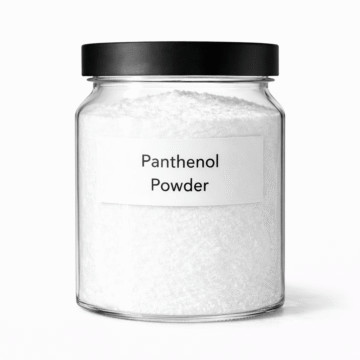
Azelaic Acid Powder works powerfully alongside several complementary brightening and barrier-support actives. Pairing it with Niacinamide Powder creates a comprehensive redness, pore, and pigmentation correction system. As a result, you address multiple skin concerns simultaneously in one formula. Furthermore, combining it with Tranexamic Acid Powder creates a powerful multi-pathway brightening formulation. Together, these actives inhibit melanin production through different biological pathways. Therefore, their combined effect is significantly stronger than either ingredient used alone. For rosacea-focused formulations, pair Azelaic Acid with Panthenol, Centella Asiatica Extract, and Allantoin for a deeply calming and redness-reducing treatment.
Who Benefits Most from Azelaic Acid Powder Formulations
Azelaic Acid Powder is genuinely one of the most inclusive skincare actives available. It suits virtually all skin types. However, it delivers the most dramatic results for specific skin concerns. It is ideal for skin dealing with active acne and post-acne marks simultaneously. Furthermore, it is exceptionally beneficial for rosacea-prone skin that cannot tolerate conventional acne actives. It is also outstanding for melasma, particularly in women experiencing hormonal pigmentation changes. Moreover, it is one of the safest brightening actives for deeper and melanin-rich skin tones where pigmentation concerns are most persistent. Because of its gentleness, it is also suitable for sensitive skin that reacts badly to stronger brightening alternatives.
Formulation Applications
Azelaic Acid Powder suits a wide range of product types. These include brightening facial serums and ampoules, rosacea-calming moisturizers and creams, acne spot treatments and blemish gels, post-acne mark fading creams, tone-correcting daily moisturizers, targeted melasma treatment serums, anti-redness toners and essences, and sensitive skin clarifying formulations.
Solubility, Appearance & Storage
Azelaic Acid Powder presents as a fine white crystalline powder with a neutral aroma. It has limited water solubility at room temperature. As a result, it requires proper dispersion technique for smooth integration into formulations. It is stable within a pH range of 4.0 – 5.5. Store it in a cool, dry, and tightly sealed container away from direct sunlight and moisture. Because it is a stable organic acid, it maintains its potency well when stored correctly. Therefore, it is a reliable long-term stock ingredient for any professional formulation studio.
Frequently Asked Questions About Azelaic Acid Powder
Can I use Azelaic Acid with Retinol? Yes, but introduce them gradually. Both are active exfoliants. Therefore, start by using them on alternate evenings to assess your skin’s tolerance before combining them in a single routine.
Is Azelaic Acid safe during pregnancy? Azelaic Acid is considered one of the safer brightening actives during pregnancy. However, always advise customers to consult their healthcare provider before using any active skincare ingredient during pregnancy or nursing.
How long does it take to see results? Most users notice improvements in redness and clarity within four to six weeks of consistent use. Post-acne marks and melasma typically show visible improvement after eight to twelve weeks.
Why does my Azelaic Acid formulation feel slightly gritty? This is a common challenge. It occurs when the powder is not properly pre-dispersed. Furthermore, using high-shear mixing and a glycerin pre-dispersion step significantly improves the final texture of your finished product.
Safety & Patch Test
Azelaic Acid Powder is generally well-tolerated at recommended concentrations. Nevertheless, always perform a patch test before full application. Some individuals experience mild tingling or temporary redness on first use. This is normal and typically subsides with continued use. However, if significant irritation persists, reduce the concentration in your formulation. Avoid contact with eyes and mucous membranes. Consult a healthcare professional if you are pregnant, nursing, or managing a skin condition. For external use only. Keep out of reach of children.
Product Details
INCI Name: Azelaic Acid
Natural Source: Derived from grains including wheat, barley, and rye
Appearance: Fine white crystalline powder
Aroma: Neutral
Solubility: Limited water solubility — pre-disperse in glycerin before adding to water phase
Comedogenic Rating: 1 (Very low)
Recommended Usage Rate: 5% – 10%
Optimal pH Range: 4.0 – 5.5
Addition Phase: Pre-dispersed in glycerin, then added to heated water phase
Suitable Skin Types: All skin types, especially acne-prone, rosacea, sensitive, and hyperpigmented skin
Key Actives to Pair With: Niacinamide, Tranexamic Acid, Panthenol, Alpha Arbutin, Allantoin, Centella Asiatica
Applications: Brightening serums, rosacea creams, acne spot treatments, melasma treatments, tone-correcting moisturizers, and sensitive skin clarifying formulations
| Weight | N/A |
|---|---|
| Dimensions | N/A |
| size | 50g, 100g, 250g |
Be the first to review “Azelaic Acid Powder”
You must be logged in to post a review.
Related products
Active Ingredients
Active Ingredients
Active Ingredients
Active Ingredients
Active Ingredients
Active Ingredients
Carrier Oils
Active Ingredients
Reviews
There are no reviews yet.