Sodium hydroxide-Lye

Price range: ₦1,300.00 through ₦15,800.00
Sodium Hydroxide Lye Powder (Sodium Hydroxide) is a high-purity alkaline compound used as a pH adjuster and saponifying agent in cold-process soap making and cosmetic formulation. It transforms oils and butters into hard bar soaps through saponification. Essential for cold-process soap bars, solid shampoo bars, and pH-adjusted skincare products. Always add NaOH to water — never the reverse. Wear protective gloves and eyewear at all times. For professional formulation use only.
Sodium Hydroxide (Lye) Powder is a high-purity alkaline compound essential in professional cosmetic formulation and soap making. It serves two critical functions. First, it acts as a precise pH adjuster in skincare and cleansing formulations. Second, it acts as the primary saponifying agent in cold-process and hot-process soap making. Because of its strong alkalinity, formulators use it in carefully controlled and calculated amounts. As a result, it creates safe, stable, and high-performing skincare and cleansing products. At Organicsbyjumira, we supply high-purity cosmetic-grade Sodium Hydroxide Powder. Therefore, your formulations meet professional quality and safety standards every time.
How Sodium Hydroxide Works in Formulation
Sodium Hydroxide works through the chemical process of saponification. During this process, NaOH reacts with oils, butters, and fatty acids. As a result, it transforms them into soap molecules and glycerin. This reaction forms the foundation of all traditional bar soap production. Furthermore, in smaller quantities, Sodium Hydroxide raises the pH of formulations quickly and accurately. Therefore, formulators rely on it to correct and stabilize the pH of creams, gels, serums, and cleansing systems. Because it is fully water-soluble, it dissolves completely and integrates cleanly into water-based formulation systems.
Sodium Hydroxide vs Potassium Hydroxide — Key Differences
Both Sodium Hydroxide and Potassium Hydroxide are alkali saponifying agents. However, they produce distinctly different soap types. Sodium Hydroxide (NaOH) produces firm and hard bar soaps. Potassium Hydroxide (KOH), on the other hand, produces soft and liquid soaps. This is because sodium-based soaps form a harder and more compact molecular structure. As a result, NaOH is the preferred choice for cold-process bar soap making, shampoo bars, and solid cleansing bars. Furthermore, NaOH-based bar soaps tend to have a longer shelf life and firmer texture than KOH-based liquid alternatives.
Uses of Sodium Hydroxide in Cosmetic Formulation
Sodium Hydroxide suits a wide range of professional cosmetic formulation applications. In cold-process soap making, it saponifies oils and butters to create hard, cleansing bar soaps with natural glycerin. In pH adjustment, small precise amounts raise the pH of acidic formulations to achieve the correct stability and skin compatibility. In emulsion systems, it neutralizes fatty acids to form stable soap-based emulsifiers. Furthermore, it supports the production of cleansing bars, solid shampoo bars, and specialty formulations requiring controlled alkalinity. Together, these applications make Sodium Hydroxide one of the most essential functional ingredients in professional cosmetic science.
Recommended Usage Rate & Formulation Guidance
Use Sodium Hydroxide at carefully calculated amounts depending on your formulation goal. For pH adjustment in skincare formulations, use it in very small, precise amounts at 0.1% – 1%. For cold-process soap making, always calculate the exact NaOH quantity using a reliable lye calculator. This ensures the correct oil-to-lye ratio for full saponification. Furthermore, it prevents unreacted lye in the finished bar soap. Always conduct a full cure period of 4–6 weeks after making cold-process soap. As a result, all residual NaOH fully neutralizes and the soap becomes safe for skin use.
Critical Safety Instructions for Handling Sodium Hydroxide
Sodium Hydroxide is a caustic substance in its raw form. Therefore, handle it with extreme care at all times. Always wear protective gloves, safety goggles, and long sleeves when working with NaOH. Always add Sodium Hydroxide to water slowly and carefully. Never pour water directly onto solid NaOH. This is because the dissolution reaction generates intense heat rapidly. Adding water to NaOH, rather than the reverse, can cause a violent and dangerous reaction. Furthermore, always work in a well-ventilated area as fumes are produced during dissolution. Keep Sodium Hydroxide away from children and store it in a tightly sealed container away from moisture. Because NaOH is hygroscopic, even brief exposure to air causes it to absorb moisture and degrade.
Solubility, Appearance & Storage
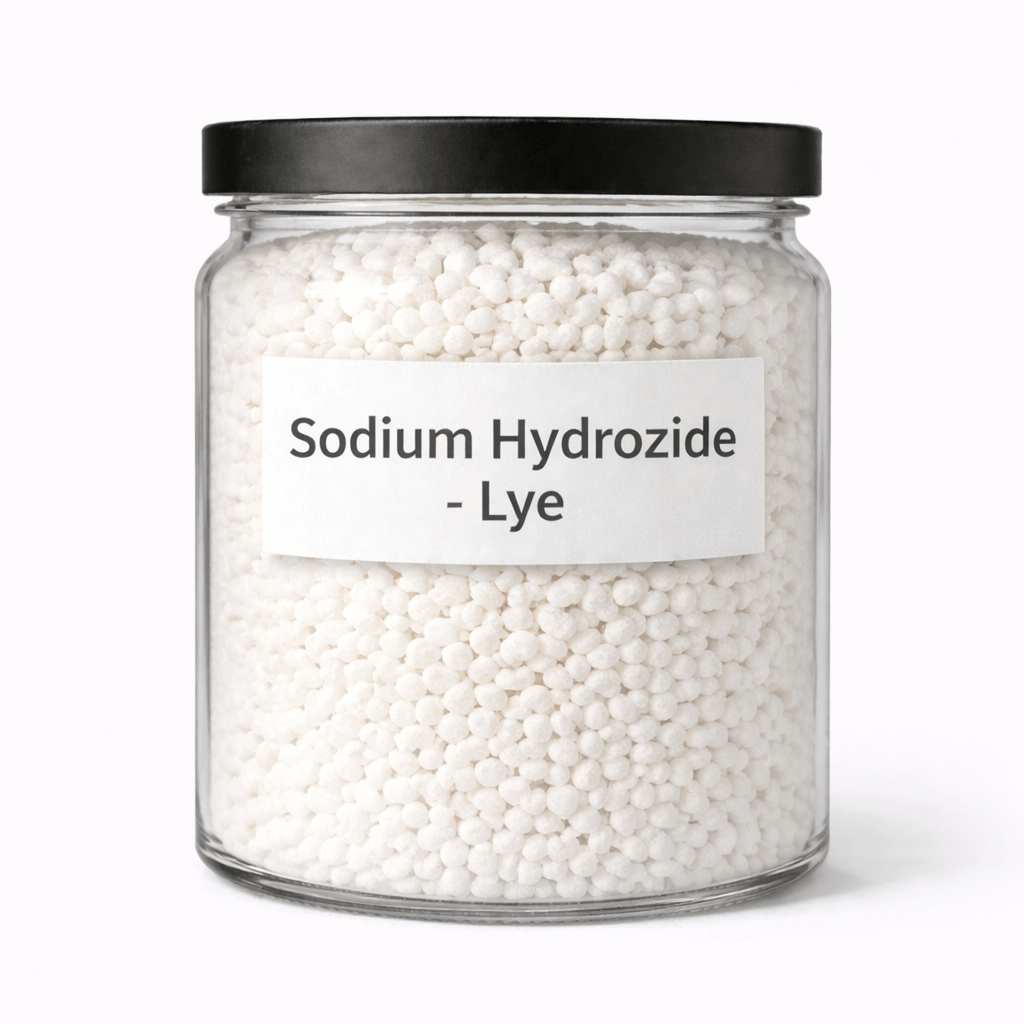
Sodium Hydroxide Powder presents as fine white powder or small white pellets. It is fully soluble in water and dissolves rapidly with the generation of significant heat. As a result, always allow the NaOH solution to cool completely before incorporating it into your formulation. Its solution pH measures between 13 – 14, reflecting its strongly alkaline nature. Store Sodium Hydroxide in a cool, dry, and tightly sealed container away from direct sunlight and moisture. Because it is highly hygroscopic, always reseal the container immediately after every use.
Best Ingredient Pairings for NaOH Formulations
Sodium Hydroxide works alongside a range of complementary formulation oils and ingredients. In cold-process soap making, pair it with skin-loving oils such as Coconut Oil, Olive Oil, Castor Oil, and Shea Butter. Together, these oils create bar soaps with excellent lather, cleansing ability, and skin conditioning properties. Furthermore, adding Vegetable Glycerin to your soap formulations boosts humectant benefits. As a result, your finished soap bars hydrate and cleanse simultaneously. For pH adjustment applications, pair it with active skincare ingredients that require precise pH calibration for maximum efficacy.
Who Should Use Sodium Hydroxide Powder
Sodium Hydroxide suits experienced cosmetic formulators and soap makers. It is ideal for those producing cold-process bar soaps, solid shampoo bars, cleansing bars, and pH-adjusted skincare formulations. Furthermore, it suits professional formulation studios, natural skincare brands, and advanced DIY soap makers. However, it is not recommended for beginners without proper formulation training. Because NaOH is caustic in its raw form, prior knowledge of safe lye handling and saponification calculations is essential before use.
Formulation Applications
Sodium Hydroxide Powder suits a wide range of product types. These include cold-process bar soaps, solid shampoo and conditioner bars, shaving soap and cream bars, cleansing bars and facial soap bars, pH adjustment in serums, toners, and emulsions, specialty solid cosmetic formulations, and professional soap making at all production scales.
Safety Disclaimer
Sodium Hydroxide is a caustic chemical for professional formulation use only. Always use appropriate protective equipment when handling. Never apply it directly to the skin. Avoid direct contact with skin or eyes. If skin contact occurs, rinse immediately with plenty of cool water. If eye contact occurs, rinse thoroughly and seek medical attention immediately. Always run stability and pH tests before finalizing any formulation. Keep out of reach of children. Organicsbyjumira is not responsible for misuse or improper handling of this ingredient.
Product Details
INCI Name: Sodium Hydroxide
Also Known As: Lye, NaOH, Caustic Soda
Appearance: Fine white powder or small white pellets
Solubility: Fully water soluble
Solution pH: 13 – 14 (strongly alkaline)
Comedogenic Rating: 0
Recommended Usage Rate: 0.1% – 1% for pH adjustment, or per lye calculator for soap making
Addition Method: Always add NaOH to water — never add water to NaOH
Key Pairings: Coconut Oil, Olive Oil, Castor Oil, Shea Butter, Vegetable Glycerin
Applications: Cold-process bar soap making, solid shampoo bars, pH adjustment, cleansing bars, shaving soaps, and specialty solid formulations
Safety: Caustic — wear protective gloves and eyewear at all times. For professional formulation use only.
| Weight | N/A |
|---|---|
| Dimensions | N/A |
| size | 250g, 500g, 1kg, 3kg |
Be the first to review “Sodium hydroxide-Lye”
You must be logged in to post a review.
You may also like…
Active Skincare Ingredients Nigeria
Active Skincare Ingredients Nigeria
Active Skincare Ingredients Nigeria
Related products
Essential Oils
Active Skincare Ingredients Nigeria
Active Skincare Ingredients Nigeria
Carrier Oils
Carrier Oils
Melt & pour base
Active Skincare Ingredients Nigeria
Active Skincare Ingredients Nigeria
Reviews
There are no reviews yet.