
Skincare Formulation & Ingredients
Skincare Formulation for Beginners in Nigeria: Essential Ingredients Guide
Aug
Introduction: Want to Start Making Skincare Products?
You have probably seen the videos.
A few oils are poured into a beaker. A beautiful cream comes together. An active ingredient is added. The final product is packaged into an attractive jar.
It looks simple.
But once you start learning skincare formulation, the questions quickly appear:
Which ingredients do I actually need? What does each ingredient do? Which ingredients can be combined? Do I need a preservative? How do I calculate percentages? And where can I buy reliable cosmetic ingredients in Nigeria?
Skincare formulation is much more than mixing ingredients together. A good formulation requires an understanding of ingredient functions, compatibility, concentration, pH, preservation, processing and product stability.
For Nigerian formulators, there is another important consideration: your ingredients must also be sourced conveniently and stored appropriately in a warm, humid climate.
Whether you are a beginner making your first body butter, a DIY skincare enthusiast, a cosmetic science student or an entrepreneur developing a skincare brand, understanding the fundamentals will save you money, reduce formulation mistakes and help you create better products.
At Organicsbyjumira, our goal is to make that learning and sourcing journey easier by providing cosmetic raw materials, skincare ingredients and selected finished skincare products online in Nigeria.
What Is Skincare Formulation?
Skincare formulation is the process of selecting, combining and processing cosmetic ingredients to create a product with a specific purpose, texture, appearance, stability and user experience.
A formulation might be designed to create:
- Facial serums
- Body oils
- Body butters
- Creams and lotions
- Cleansers
- Toners
- Scrubs
- Masks
- Balms
- Hair and scalp products
- Soap and wash products
The important difference between formulation and simply following a recipe is understanding why each ingredient is included.
For example, glycerin is not simply added because it appears in a formula. It has a specific functional role as a humectant.
Likewise, an emulsifier is not just another ingredient in a cream. It helps create and maintain a stable mixture between water and oil phases.
That understanding is what allows a formulator to develop, troubleshoot and eventually modify formulas intelligently.
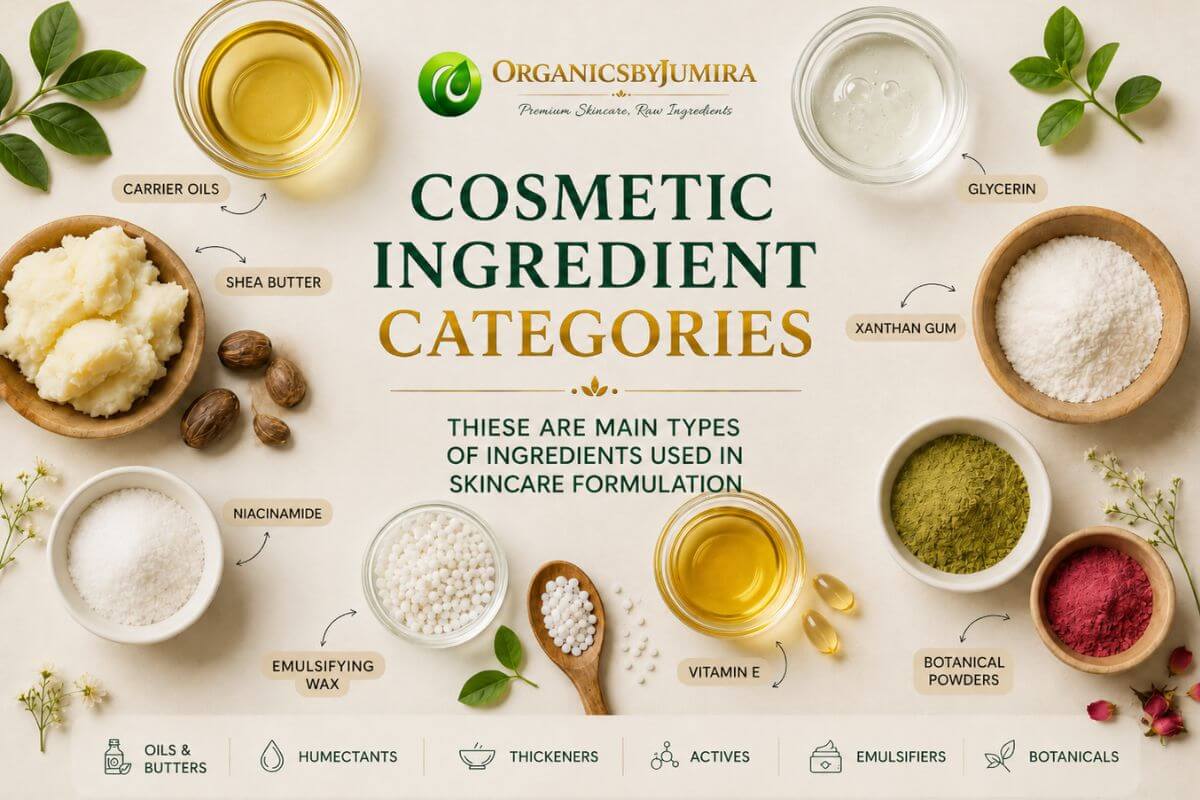
The Main Types of Ingredients Used in Skincare Formulation
Before buying dozens of cosmetic ingredients, beginners should understand the major ingredient categories.
1. Base Ingredients
Base ingredients make up a significant portion of a formulation.
Depending on the product, your base could include:
- Distilled or purified water
- Carrier oils
- Plant butters
- Aloe vera
- Hydrosols
- Soap bases
- Other cosmetic bases
For example, an oil-based facial oil may contain mostly carrier oils and oil-soluble ingredients, while a water-based serum may contain predominantly water and water-soluble ingredients.
2. Humectants
Humectants help attract and hold water within a formulation and can contribute to a hydrated skin feel.
Common examples include:
- Vegetable glycerin
- Propanediol
- Hyaluronic acid
- Urea
Humectants are particularly useful in products such as:
- Facial serums
- Toners
- Moisturisers
- Lotions
- Gels
However, simply adding more humectant does not automatically make a product better. Concentration, formulation structure and sensory properties all matter.
3. Emollients and Carrier Oils
Emollients contribute to skin feel, softness and lubrication.
Carrier oils are especially important in oil-based formulations.
Popular examples include:
- Jojoba oil
- Argan oil
- Rosehip oil
- Grapeseed oil
- Avocado oil
- Squalane
- Sweet almond oil
Different oils have different fatty-acid profiles, textures, oxidation characteristics and sensory properties.
For a Nigerian formulator, storage is also important. Heat, light and oxygen can accelerate oxidation of susceptible oils.
This means your ingredient storage system matters almost as much as your ingredient selection.
Natural oil does not automatically mean oxidation-proof.
4. Plant Butters
Butters can contribute richness, structure and occlusivity to formulations.
Common cosmetic butters include:
- Shea butter
- Cocoa butter
- Mango butter
- Avocado butter
They are commonly used in:
- Body butters
- Balms
- Lip products
- Hair products
- Creams
- Massage products
For beginners, shea butter is often a useful starting material because it can be incorporated into many simple anhydrous formulations.
5. Emulsifiers
If you want to make a conventional cream or lotion containing both water and oil, you generally need an appropriate emulsification system.
Water and oil naturally separate.
An emulsifier helps bring these phases together into a more stable emulsion.
Common formulation ingredients include:
- Emulsifying wax
- Olivem-type emulsifiers
- Other specialised emulsifying systems
The choice of emulsifier depends on the formulation, desired texture, oil phase, processing method and manufacturer specifications.
Important: Do not assume that any waxy ingredient can automatically emulsify a cream.
6. Thickeners and Stabilizers
These ingredients can influence viscosity, texture and stability.
Examples include:
- Xanthan gum
- Carbomer
- Cetyl alcohol
- Stearic acid
- Other rheology modifiers
For example, xanthan gum is frequently used in water-based formulations to increase viscosity and help suspend or stabilize certain ingredients.
The correct choice depends on the type of product being formulated.
7. Active Ingredients
Actives are ingredients selected because they provide a particular cosmetic function or benefit.
Examples available in the cosmetic ingredient market include:
- Niacinamide
- Alpha arbutin
- Azelaic acid
- Allantoin
- Vitamin C derivatives
- Tranexamic acid
- Hyaluronic acid
- Panthenol
One of the biggest beginner mistakes is thinking that a formula containing more actives automatically produces a better product.
It does not.
A well-designed formulation considers:
- Recommended usage rate
- Solubility
- pH requirements
- Compatibility
- Stability
- Processing temperature
- Packaging
- Preservation
A simpler, well-formulated product can be considerably better than a formula containing ten poorly selected actives.
8. Preservatives
This is one area where beginners should be especially careful.
If a formulation contains water or other ingredients that can support microbial growth, preservation becomes a critical part of product development.
A preservative system must be selected according to the formulation and used according to the manufacturer’s recommended conditions.
Cosmetic microbiology is not something to guess.
The FDA’s cosmetic microbiology guidance notes that microorganisms and pathogens can be important safety concerns in topical cosmetics and discusses preservative efficacy testing.
This is why you should never assume that:
“Natural ingredients don’t need preservatives.”
A water-containing product can still require effective preservation regardless of whether its ingredients are natural, botanical or plant-derived.
9. Antioxidants and Chelators
Antioxidants and chelating agents can also have important roles in formulation.
For example, antioxidants may help reduce oxidation-related deterioration in formulations containing oxidation-sensitive oils.
Chelating agents can bind certain metal ions and may support formulation stability and preservation systems.
Their inclusion should be based on the formulation rather than simply adding ingredients because they are popular.
Understanding Water-Based vs Oil-Based Skincare Products
One of the easiest ways for a beginner to understand formulation is to separate products into broad formulation types.
| Product Type | Typical Major Phase | Key Considerations |
|---|---|---|
| Facial oil | Oil | Oil selection, oxidation, antioxidants, packaging |
| Body oil | Oil | Skin feel, oil selection, fragrance/EO safety |
| Body butter | Oil | Butter/oil ratio, texture, melting behaviour |
| Serum | Water or oil | Solubility, pH, preservation if water-based |
| Toner | Water | Preservation, pH, solubility |
| Lotion | Water + oil | Emulsification, preservation, viscosity |
| Cream | Water + oil | Emulsifier, stability, texture, preservation |
| Cleanser | Water + surfactants | Surfactant system, viscosity, pH, preservation |
This distinction is extremely important.
A water-soluble ingredient cannot simply be added to an oil-based formula and expected to dissolve.
Likewise, an oil-soluble active may require an appropriate oil phase or solubilisation system.
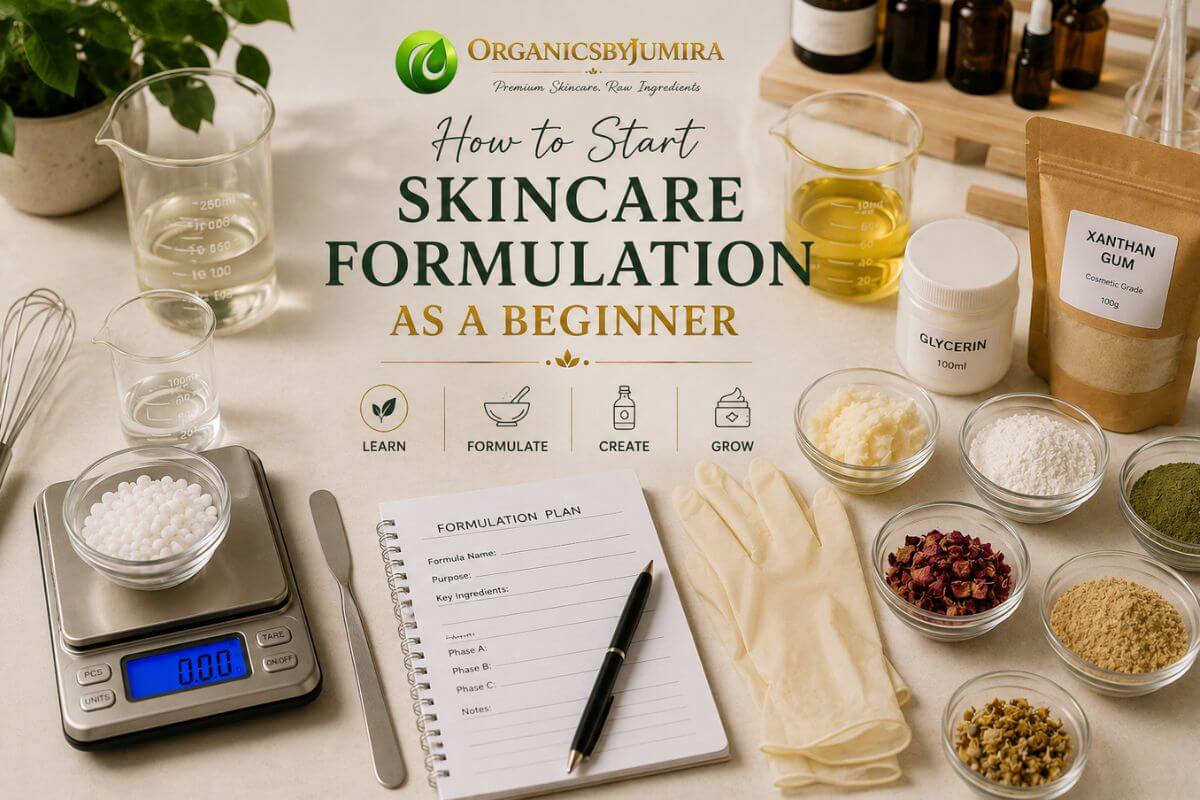
How to Start Skincare Formulation as a Beginner
You do not need to buy every ingredient in a supplier’s catalogue.
In fact, doing so can make learning harder.
Instead, build your ingredient collection gradually.
Step 1: Choose One Product
Start with one product rather than trying to formulate:
- Face cream
- Body lotion
- Serum
- Toner
- Cleanser
- Scrub
- Body butter
all at once.
A simple anhydrous product such as a body oil or body butter can help you learn basic weighing, ingredient percentages and batch calculations before progressing to more complex emulsions.
Step 2: Learn Ingredient Functions
Before purchasing an ingredient, ask:
What does this ingredient do?
For example:
| Ingredient | General Formulation Role |
|---|---|
| Glycerin | Humectant |
| Shea butter | Emollient/structuring lipid |
| Jojoba oil | Emollient |
| Xanthan gum | Thickener/rheology modifier |
| Emulsifying wax | Emulsifier |
| Niacinamide | Cosmetic active |
| Vitamin E | Antioxidant |
| Citric acid | pH adjustment/acidulant |
| Preservative | Microbial control |
The exact function and suitable concentration depend on the ingredient specification and final formulation.
Step 3: Think in Percentages, Not Spoonfuls
Professional formulation is normally based on percentages by weight.
A 100 g formulation makes the calculation particularly easy.
For example:
- Ingredient A — 60%
- Ingredient B — 20%
- Ingredient C — 10%
- Ingredient D — 5%
- Ingredient E — 5%
Total = 100%
If you later want to make 500 g, the percentages remain the same and the quantities are scaled accordingly.
This is much more reliable than measuring ingredients using kitchen spoons.
Step 4: Use a Digital Scale
A reliable digital scale is one of the most useful tools for a beginner formulator.
Avoid estimating ingredients by:
- Spoonful
- Bottle cap
- “One handful”
- Eye measurement
Small formulation errors can significantly change the final percentage, particularly when working with potent ingredients.
Step 5: Keep a Formulation Record
Record:
- Formula name
- Batch size
- Date
- Ingredient names
- INCI names where applicable
- Supplier
- Batch information
- Percentage
- Weight
- Processing temperature
- Mixing procedure
- pH where applicable
- Observations
- Packaging
- Stability observations
Good documentation becomes increasingly important when you move from DIY projects into commercial skincare production.
NAFDAC’s published guidance for registration of cosmetics made in Nigeria is an important regulatory reference for businesses developing products for the Nigerian market.
Where to Buy Cosmetic Ingredients in Nigeria
Finding the right ingredient is only half the job.
You also need a supplier that makes it easier to understand what you are buying.
When sourcing cosmetic raw materials in Nigeria, look for:
1. Clear Ingredient Identification
Look for the proper ingredient name and relevant product information.
2. Usage Guidance
Where applicable, suppliers should provide information that helps formulators understand how an ingredient is normally used.
3. Appropriate Packaging
Ingredients should be packaged in a way that helps protect them from contamination, moisture, heat or light where relevant.
4. Storage Information
Some ingredients are particularly sensitive to:
- Heat
- Moisture
- Oxygen
- Light
This is especially relevant in Nigeria’s warm climate.
5. Suitable Order Sizes
Beginners and small businesses may not need industrial quantities.
Being able to purchase smaller quantities can reduce unnecessary inventory and allow you to test formulations before scaling.
Source Your Skincare Ingredients Online
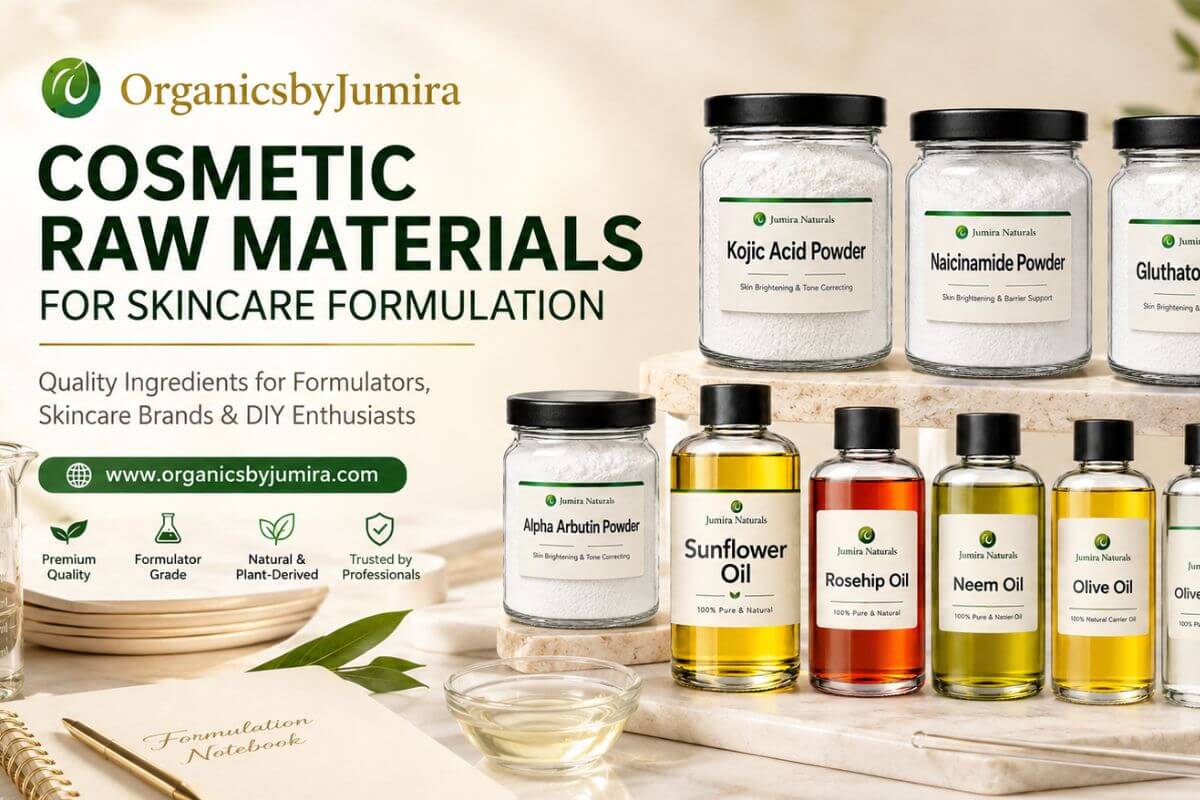
Organicsbyjumira’s online shop currently carries a broad range of cosmetic raw materials, including active ingredients, natural oils, butters and extracts, formulation ingredients, local ingredients, soap and cream bases, and other formulation supplies.
Explore Cosmetic Raw Materials at Organicsbyjumira
For formulators specifically looking for actives, the Active Skincare Ingredients collection includes ingredients such as allantoin, alpha arbutin, azelaic acid, collagen powder, dimethicone, EDTA and preservatives.
Browse Active Skincare Ingredients
What Should a Beginner Buy First?
Instead of buying 30 ingredients, build a small and useful starter collection.
A beginner’s ingredient shelf could include:
Basic Oil-Based Formulation
- Shea butter
- Jojoba oil
- Grapeseed oil or another suitable carrier oil
- Vitamin E
- An appropriate fragrance or essential oil, where suitable
Basic Water-Based Formulation
- Distilled water
- Glycerin
- Xanthan gum or another suitable thickener
- A suitable preservative
- pH adjustment ingredients
Moving Into Advanced Formulations
Once you understand the basics, you can gradually add:
- Emulsifiers
- Surfactants
- Cosmetic actives
- Botanical extracts
- Chelators
- Specialized rheology modifiers
- Solubilizers
- Antioxidants
This approach helps you learn what each ingredient actually contributes instead of creating a crowded ingredient shelf that you don’t know how to use.
Common Skincare Formulation Mistakes Beginners Make
Mistake 1: Copying Viral Recipes
A TikTok or Instagram recipe is not automatically a professionally developed formula.
Consider:
- Ingredient percentages
- pH
- Preservation
- Compatibility
- Stability
- Packaging
- Product intended use
before making a formulation.
Mistake 2: Adding Too Many Actives
More is not necessarily better.
Combining multiple high-impact actives without understanding their compatibility can create unnecessary formulation complexity.
Start with a clear product objective.
Mistake 3: Ignoring Preservation
If your formulation contains water, don’t treat preservation as optional.
The preservation system must be appropriate for the formula and used correctly.
Mistake 4: Measuring by Volume
Cosmetic formulation is generally more reproducible when ingredients are weighed accurately.
Use a scale rather than guessing quantities.
Mistake 5: Ignoring pH
Many water-based skincare ingredients and preservatives have specific pH considerations.
A product can look perfectly fine while still having a formulation problem that isn’t visible to the eye.
Mistake 6: Buying Ingredients Without Understanding Their Function
Before purchasing an ingredient, know:
- What is it?
- Why am I using it?
- How much should I use?
- What does it need to work properly?
- What ingredients may be incompatible with it?
These questions will make you a much better formulator.
Why Ingredient Quality Matters
A formulation can be technically correct on paper and still perform poorly if the raw materials are inconsistent, degraded, incorrectly identified or improperly stored.
This is especially relevant when working with:
- Natural oils
- Plant butters
- Botanical powders
- Extracts
- Sensitive active ingredients
For a skincare business, consistency matters because your customers expect one batch to resemble the next.
Your formulation notebook, supplier information and batch records therefore become valuable business assets.
Skincare Formulation in Nigeria: Think Beyond the Formula
If you are formulating products to sell in Nigeria, formulation is only one part of the process.
You also need to think about:
- Product safety
- Ingredient sourcing
- Packaging
- Labelling
- Batch records
- Stability
- Microbiological considerations
- Product claims
- Regulatory requirements
- Customer expectations
- Production consistency
NAFDAC provides specific guidance for cosmetic product registration in Nigeria, so commercial formulators should consult current regulatory requirements rather than relying solely on social-media advice.
This is particularly important if your goal is to move from making products for yourself to selling them commercially.
A Simple Learning Path for New Formulators
If you’re completely new to skincare formulation, consider progressing in this order:
Level 1 — Understand Ingredients
Learn:
- Oils
- Butters
- Humectants
- Thickeners
- Preservatives
- Emulsifiers
- Actives
Level 2 — Learn Formulation Mathematics
Understand:
- Percentages
- Weight conversion
- Batch scaling
- Phase calculations
Level 3 — Start with Simple Formulations
Practice:
- Body oils
- Body butters
- Balms
Level 4 — Move to Water-Based Products
Learn:
- pH
- Preservation
- Solubility
- Water quality
- Microbial control
Level 5 — Learn Emulsions
Study:
- Oil phase
- Water phase
- Emulsification
- Heating
- Cooling
- Viscosity
- Stability
Level 6 — Develop Professionally
Learn about:
- Stability testing
- Microbiological testing
- Documentation
- Packaging compatibility
- Good manufacturing practices
- Regulatory requirements
This progression is far more useful than trying to memorise hundreds of ingredients at once.
Organicsbyjumira: Your Source for Cosmetic Raw Materials in Nigeria
For Nigerian formulators, sourcing should not be another obstacle to learning and developing products.
Organicsbyjumira combines a skincare product collection with a growing range of cosmetic raw materials for people who want to formulate, experiment, develop products or build skincare businesses.
The current catalogue includes categories such as Active Ingredients, Natural Oils, Butters & Extracts, Formulation Ingredients, Local Ingredients, Soap and Cream Bases, and Spa & Wellness ingredients.
You can browse the range online and select ingredients according to the needs of your formulation.
Ready to Start Sourcing?
Frequently Asked Questions
What is skincare formulation?
Skincare formulation is the process of selecting and combining cosmetic ingredients in specific proportions and processing them correctly to create a safe, stable and functional cosmetic product.
What ingredients should a beginner buy for skincare formulation?
Start with a small selection appropriate to the type of product you want to make. For example, a beginner exploring anhydrous products might start with a few carrier oils, shea butter and an antioxidant. Water-based products require additional consideration for preservation, pH and microbial control.
Can I start skincare formulation at home?
You can learn basic formulation in a controlled home environment, but products intended for commercial sale require much greater attention to hygiene, documentation, testing, safety and applicable regulatory requirements.
Do water-based skincare products need preservatives?
Generally, water-containing cosmetic products require an appropriate preservation strategy because water can support microbial growth. The correct preservative system depends on the formulation and must be used according to the supplier’s specifications.
Where can I buy skincare ingredients in Nigeria?
You can source cosmetic ingredients from specialist suppliers, physical raw-material markets and online ingredient stores. When choosing a supplier, consider ingredient identification, storage, product information, order sizes and consistency.
Organicsbyjumira offers cosmetic raw materials and skincare ingredients online for Nigerian formulators.
What is the difference between a carrier oil and an active ingredient?
A carrier oil is generally used as part of the oil phase and contributes to the product’s emollience and sensory characteristics. An active ingredient is selected primarily for a specific cosmetic function or performance objective.
Can I mix any skincare ingredients together?
No. Ingredient compatibility depends on factors such as solubility, pH, concentration, temperature, phase and chemical stability. Always research an ingredient’s technical requirements before incorporating it into a formula.
How do I start a skincare business in Nigeria?
Start by learning formulation and product safety, choosing a clear product concept, sourcing suitable ingredients, developing and testing your formulas, establishing appropriate documentation and understanding the applicable Nigerian regulatory requirements before commercial launch.
Ready to Start Your Formulation?
Good skincare formulation starts with more than a list of trending ingredients.
It starts with knowledge, accurate measurements, appropriate raw materials and a clear understanding of what each ingredient is doing in your formula.
Whether you’re making your first body butter, developing a facial serum or building the next Nigerian skincare brand, take the time to learn the fundamentals and source your ingredients carefully.
When you’re ready to find the ingredients for your next formulation, explore Organicsbyjumira’s online collection of cosmetic raw materials and skincare ingredients.
Your next formulation could start with the right ingredient.
